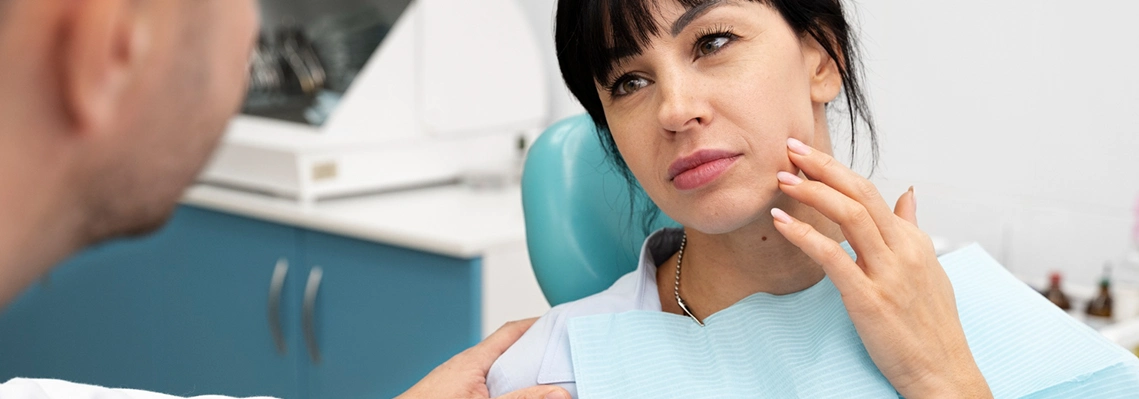
Jaw stiffness when you wake up, a clicking sound while chewing, or persistent facial discomfort are symptoms many people experience but often ignore. Some assume it’s stress, others blame posture or muscle strain, while a few wonder if it’s a dental issue. Temporomandibular joint disorders (TMJD), which can be linked to bite and alignment issues, affect approximately 5%–12% of the population, making jaw pain a relatively common concern.
The confusion is understandable; jaw pain can have multiple causes. But there is one more factor that dental experts often overlook: misaligned teeth. The manner in which your teeth fit together directly influences your jaw motion as well as the level of strain that your jaw joints and muscles experience.
In this blog, we study the relationship between misaligned teeth and painful jaws with expert-backed information, helping you understand when your discomfort may be more than just temporary tension.
Learn how correcting teeth alignment can ease jaw pain.
A] What Are Misaligned Teeth?
Misaligned teeth is the term used to refer to the teeth that are not aligned in the proper position when the mouth is closed. Ideally, the lower and upper teeth should come into contact, and the jaw should have a normal movement in chewing and talking. Even a slight misalignment can alter the distribution of bite pressure.
This problem is commonly referred to as malocclusion. Most individuals relate misalignment with cosmetic issues, such as crooked teeth; however, dentists insist that alignment has a functional aspect. Misalignment may affect chewing efficiency, speech articulation, and jaw stability.
With time, such functional problems can also cause discomfort, muscle tension, and jaw pain. Misalignment is not only a health problem but also an aesthetic one.
B] Common Types of Dental Misalignment
Dental misalignment may occur in various ways, with each having a different influence on jaw movement:
1. Overbite and Underbite
An overbite is described as the overlapping of the upper teeth with the lower teeth, whereas an underbite is the overgrowth of the lower teeth over the upper teeth.
The two disorders may result in the jaw being bound in unnatural postures, which, over time, put strain on the jaw joint.
2. Crossbite and Open Bite
It is an undercut bite in which the upper teeth are placed within the lower teeth rather than being placed outside the lower teeth.
With an open bite, there is no contact between the front teeth. They both cause a loss of chewing efficiency and jaw imbalance.
3. Crowding and Spacing Issues
The teeth may be overcrowded or spaced too widely, reducing bite pressure so that some teeth and jaw muscles are overworked compared to others.
C] How Are Misaligned Teeth Connected to Jaw Pain?
The correlation between tooth misalignment and jaw pain is more mechanical. The muscles of your jaw and the temporomandibular joint (TMJ) and your teeth are coordinated to work as a unit. When there is an offset, the system corrects, usually at some expense.
1. Uneven Bite Pressure on the Jaw
Misalignment leads to an uneven distribution of bite forces. Some regions of the jaw experience greater stress, leading to local strain and pain.
2. Stress on the Temporomandibular Joint (TMJ)
TMJ is a joint that joins the skull and the jaw. The problems with the TMJ and crooked teeth often occur together because the misalignment interferes with jaw movement. In the long run, this may result in inflammation, clicking, or pain.
3. Muscle Fatigue and Overcompensation
Poor alignment may be met by overworking the jaw and facial muscles. This continuous overwork may cause muscle fatigue, tension headaches, and jaw stiffness, as well as long-term symptoms of jaw pain associated with dental problems.
D] What Causes Misalignment of Teeth?
Aching teeth causes may occur as a result of genetic factors as well as lifestyle:
1. Genetics and Jaw Structure
Genetic jaw size and shape, as well as tooth spacing, are significant factors. The disproportionate size of the jaw and teeth will usually cause crowding or spacing.
2. Childhood Habits and Developmental Factors
Thumb sucking, prolonged pacifier use, or early loss of baby teeth may affect the growth and development of permanent teeth.
3. Teeth Grinding, Injury, or Poor Dental Care
Gradual changes in alignment can result from bruxism (teeth grinding), jaw trauma, or missing teeth, which can alter bite balance and increase the risk of jaw pain.
E] Treatment Options for Jaw Pain Caused by Misaligned Teeth
Jaw pain associated with misalignment is treated to reduce symptoms and address the underlying cause. The various treatments include:
1. Orthodontic Treatments
Clear aligners and braces for jaw pain slowly shift the teeth, enhancing the bite. Many patients report decreased jaw pain as alignment improves. Jaw pain braces are usually prescribed when malocclusion is the underlying cause.
2. Bite Correction Devices
The night guards or occlusal splints serve to reduce jaw strain, particularly for patients who grind their teeth. These appliances cushion the TMJ and muscles.
3. Supportive and Lifestyle Treatments
Dental treatment can be supplemented by physiotherapy, jaw exercises, posture correction, and stress management. These methods contribute to the rest of the overworked muscles and to the long-term health of the jaw.
Book a dental consultation to understand your jaw pain today.
Bottom Line: When Should You See Your Healthcare Provider?
You should never neglect jaw pain, particularly when it is chronic. The signs that should be evaluated by a professional include permanent jaw stiffness, inability to chew, frequent headaches, clicking or popping, and painful teeth without an apparent cause.
So, are you wondering “should I see a dentist for jaw pain”?
Early diagnosis will help avoid complications in the long term, including chronic TMJ disorders. A skilled Dentist In Sunshine Coast can determine whether misaligned teeth or other jaw pain is contributing to the problem and refer for appropriate treatment. Early intervention can be very crucial in improving the comfort and quality of life.
Frequently Asked Questions
1. What does “misaligned teeth” actually mean?
Misaligned teeth refer to teeth that fail to fit in each other as the mouth is closed and have an impact on bite balance and jaw action.
2. Can crooked teeth cause jaw pain or TMJ problems?
Yes. It has been found that crooked teeth and TMJ problems are closely connected, as uneven bite forces may strain the TMJ.
3. What are the common symptoms of jaw pain dental issues caused by tooth misalignment?
The symptoms include jaw stiffness, facial pain, headache, clicking, and sore teeth without cavities.
4. Why does misalignment cause strain on jaw muscles?
A lack of proper tooth alignment requires the jaw muscles to overstrain when chewing and talking, leading to fatigue and strain.
5. How is misalignment diagnosed?
Clinical examination, dental X-rays, and, occasionally, digital bite analysis are used by dentists to evaluate bone balance.
6. What happens if I ignore jaw pain caused by misalignment?
The symptoms should not be overlooked, as they can cause chronic TMJ disorders, increased pain, and decreased range of motion of the jaw in the long run.
7. Are misaligned teeth the only reason for jaw pain?
No. Jaw pain may also be caused by stress, arthritis, injury, or other muscle disorders. A dental check-up helps to diagnose the cause.
8. Can children or teens get jaw pain from misaligned teeth?
Yes. Prolonged jaw problems and reduced future pain can be prevented through early orthodontic evaluation.

Dr. Adarsh Pisharodi
Dr. Adarsh Pisharodi, serving as the principal dentist at Oris Dental, brings a wealth of expertise spanning over 26 years to his esteemed practice. Specializing in cosmetic dentistry, dental implants, and orthodontics, he takes immense pride in rejuvenating countless smiles and instilling confidence in Sunshine Coast residents. As an esteemed member of the Australian Dental Association and esteemed dental societies, he remains steadfast in delivering exceptional care to his patients.